Pages

September 20, 2011

My first baseball card: something touched me deep inside

By FRANK BARNING

It happened in the spring of 1951, just before my ninth birthday. Upon leaving my elementary school, P.S. 101 in Forest Hills, N.Y., I spied a colorful piece of paper on the ground which I promptly scooped up. It was a 1951 Bowman baseball card of Washington Senators' catcher Mickey Grasso. My life would never be the same.

I knew practically nothing about baseball and was totally unaware of baseball cards. My family would not own a television set until later in the year, so I had never seen a game. But there was something about that Mickey Grasso card that captivated me.

That baseball card changed my life, and is almost beyond words, like a religious experience or the birth of your first child. It was as though a light had been turned on.

Baseball has been a dominant force in my life every since. That's 60 years. Baseball cards and the game became my passion as a youngster. I just had to have all those 1951 Bowmans and I eventually owned all of them.

In the early 1970s, Vivian and I became baseball card collectors and eventually part-time dealers. In 1979, we created a publication devoted to baseball card collecting, Baseball Hobby News, which was published for nearly 15 years.

That 1951 Bowman Mickey Grasso still has a hold on me, as does the game as well as baseball cards.

September 19, 2011

Baseball players whose names or nicknames are body parts


BILL ZIMPLEMAN, PENNSYLVANIA
Rollie Fingers
George "Twinkle Toes" Selkirk
Mike Palm
Barry Foote
Ed Head

FRANK BARNING, NEVADA
Neal Ball
Peter LaCock
Bullet Joe Bush
Billy Cox
Woodie Held
Rusty Kuntz - - captain

RICHARD WEST, TEXAS
Ted Beard
Footsie Blair
George Bone
Mordecai "Three-Finger" Brown
Jimmy Bloodworth

JOE ZINN, NORTH CAROLINA
Heinie Manush
Eddie "Knuckles" Cicotte
Mordecai "Three Finger" Brown
Hub "Pianolegs" Pernall
Ernie "The Schnozz" Lombardi

TOM FILIBERTO, NEW YORK
Three Finger Brown
Leo "The Lip" Duroocher
Lenny "Nails" Dykstra
Rollie Fingers
Chin-Lung Hu (double body part)

TOM MORTENSON, WISCONSIN
George "Twinkletoes" Selkirk
Walt "No-Neck" Williams
Rollie Fingers
Chase Headley
Barry Foote

MEL SOLOMON, NEW JERSEY
Bill Hands
Rollie Fingers
Barry Foote
Jim Ray Hart
Harry Cheek

TOM HENNINGSEN, ILLINOIS
Bill Hands
Barry Foote
Mordecai "Three Finger" Brown
Rich Hand
Rollie Fingers

Blogger's notes:
It was said of Walt "No-Neck" Williams that he really had a head on his shoulders.

My favorite submission is from Tom Filiberto: Chin-Lung Hu (double body part).

The only player whose name is four body parts, Tony Armas. Figure it out.

September 15, 2011

My son, Randy Barning, is all a dad could have wished for

By FRANK BARNING

American journalist and humorist Helen Rowland wrote, "A man's desire for a son is usually nothing but the wish to duplicate himself in order that such a remarkable pattern may not be lost to the world".

While Vivian was expecting, friends and family would ask if I wanted a boy or a girl. I lied, saying it didn't matter.

When our son Randy was born on May 7, 1973 at Mercy Hospital in Rockville Centre, I was overjoyed that Vivian and the baby were healthy, but the icing on the cake was that I had a son.

People knew that Vivian and I were big baseball fans, both rooting for the Brooklyn Dodgers until the team moved to Los Angeles after the 1957 season. Then starting in 1962 when they were created, the New York Mets were our team. So many baby gifts were shirts and other clothing items with baseball themes. Randy even received a couple of miniature baseball gloves.

His best sport turned out to be basketball. The photo of the two of us was taken in our backyard in 1991 when Randy was on the team at La Jolla Country Day School in San Diego. One of our most memorable days was when he made the varsity in junior year and was handed his uniform.

Randy and I played a lot of basketball on a court near our home. Maybe he was around 10 when we started. We'd have shooting contests, games such as H-O-R-S-E and one-on-one competition. Sometimes we would play together in pickup games. In the early years, he was totally overmatched by a dad who was in his early 40s. But as time passed, our skills evened out.

And then came the day, around the time Randy was a freshman in high school, that the torch was passed. The son exceeded the dad and he loved to rub it in my face, in a nice way. He was so pleased with himself, and I was proud of him. Hey, he loved a sport I had played since I was a pre-teen.

When it came time to apply to colleges, Randy already knew which school he wanted. Eventually, he had an impressive choice of universities that offered him admission. The University of California system has some great schools and Randy had his choice. He did not want to stay home, so the San Diego campus was rejected even though I tried to bribe him with a new car. The top schools were the University of California Berkeley and the University of California Los Angeles (UCLA). Randy chose UCLA, about a three-hour drive or train ride from home. Vivian and I were thrilled.

I don't know if many young men who have options pick a college because of its basketball history and tradition, but our son did. He wanted to be a Bruin, the school of fabled coach John Wooden and such immortals as Lew Alcindor (Kareem Abdul Jabbar) and San Diegan Bill Walton, among others.

The first week of school, he talked to some of the assistant basketball coaches about becoming a team manager, but all the spots were taken. Instead, he played intramural basketball on the team of the fraternity he joined and attended just about all the Bruins' home games at fabled Pauley Pavilion, where all the national championship banners are hung.

In March of 1995, the team won its 11th national title and only one since coach Wooden retired in 1975. Randy was a senior and attended the Final Four games in Seattle. In June, his department's commencement was held in Pauley Pavilion, amid the banners. Three of the other grads in his department were starters on the basketball team. The master of ceremonies, as I recall, mentioned by name only three graduates. They received a standing ovation.

At age 38, Randy Barning continues to be all a dad could have wished for. An unknown author wrote, "Son, you outgrew my lap, but never my heart".
_______________________

Originally published in Early Levittown and Beyond on August 18, 2011

September 13, 2011

WHERE I WOULD RATHER BE TODAY: Cruising the Panama Canal


Click on photos to enlarge

Vivian and I have taken approximately 24 cruises. Among my favorites was our October to November 2003 voyage on Royal Caribbean’s Radiance of the Seas. It sailed from San Diego through the Panama Canal to Miami.

Royal Caribbean had an expert onboard who gave lectures on the history of building the Canal and the engineering that created it. If you are looking to take a cruise, I highly recommend this journey.

_____________

Photos by Frank Barning

August 30, 2011

Where I would rather be today: ROME


Click on photos to enlarge

I was entrapped into attending a destination wedding in Bath, England in the early spring of 2004. Vivian can be beguiling and when she is, I am an easy mark. Try getting to Bath from London, carrying two heavy suitcases and assorted goodies. Good luck.

Beguiled, we flew to Rome and after a few days on to London for a brief visit and then Bath. I enjoyed Bath and the wedding was interesting. The trip home was flights from London, to Dublin, to Boston, to Los Angeles and finally San Diego. That's the downside of flying using airline miles to obtain free tickets.

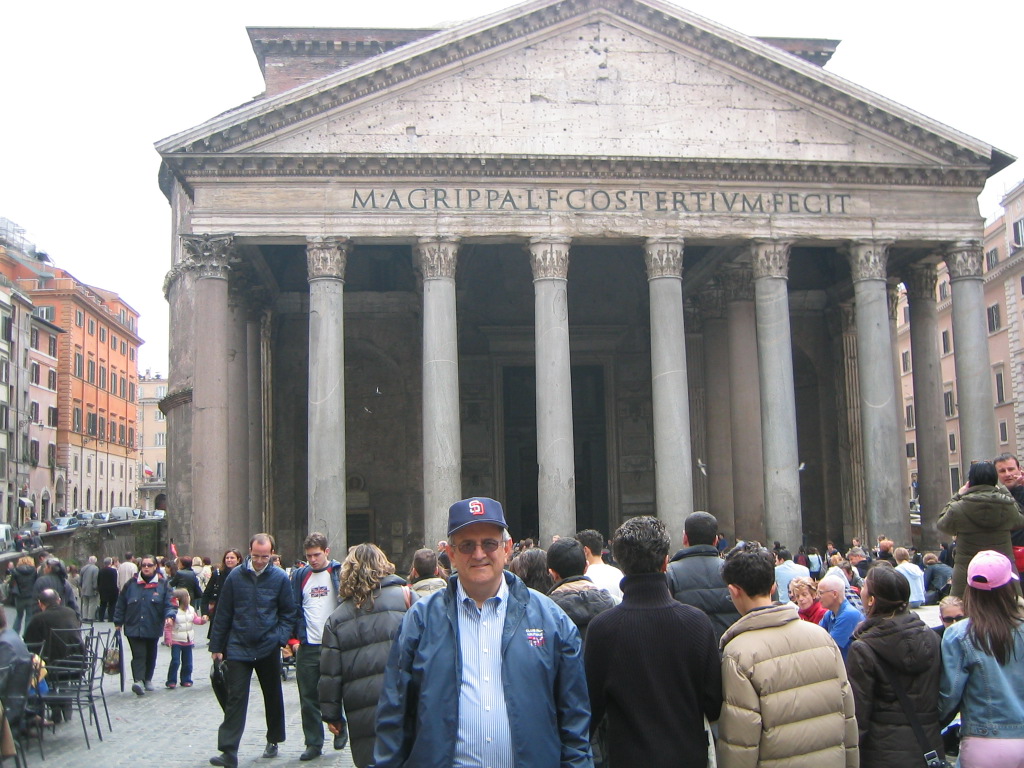
So here are some of my favorite Rome pictures. That's me in front of the Pantheon, just about my favorite historic building in the Eternal City. I had on my San Diego Padres cap and a guy wearing a San Diego Chargers jacket spotted me. It pays to wear sports gear if you enjoy chatting with strangers.

The same thing happened a few years before in Copenhagen. We needed a bathroom, and found one in a classy hotel in the middle of town. While waiting for Vivian, outside the ladies room, I spotted a man wearing a Chargers cap. It turns out he lived in the same part of San Diego as we and his wife and I recognized each other from a donut shop. The bonuses of travel just seem to pop up out of nowhere.

If I could be in any particular spot in Rome, as I write, it would be in the crowd on the Spanish Steps. It is so alive with people from all over the world, an instant happening.
Vivian and I had just climbed the Spanish steps on April 3, 1972 when we stopped for coffee at a cafe. We had just picked up a copy of the International Herald-Tribune. This was many years before the instant communication of the internet and all these new fangled accessories.

Paging through the Trib, Vivian gasped and started to cry. "You won't believe this," she weeped. My boyhood hero and one of her favorite Brooklyn Dodgers, Gil Hodges, had died of a heart attack two days shy of his 47th birthday. At the time he was the manager of the New York Mets. A heavy smoker, Gil was playing golf with his coaches in Florida and reportedly was gone before he hit the ground.

Gil's widow, still living some 40 years later, is the former Joan Lombardi from Brooklyn.

If you haven't been to Rome, put it on your bucket list. It defies the imagination. History is everywhere and the food is sensational.
_____________

Photos by Frank Barning

August 23, 2011

Where I would rather be today: TREVI FOUNTAIN IN ROME


Click on photos to enlarge

The 1954 hit song and movie "Three Coins in the Fountain" brought Rome's Trevi Fountain (Fontana Di Trevi) to the attention of Americans. The film tells the story of three American girls looking for romance in Rome while employed at the American Embassy. They drop coins in the fountain for good luck.

The song received an Academy Award that year and was a No. 1 hit by the Four Aces. Frank Sinatra and Doris Day, among others, recorded popular versions of the song.
We were disappointed to find out that Trevi Fountain is tightly surrounded by buildings so it is difficult to shoot a panorama photo. Close ups of the various statues work best.

The central figure of the fountain, in front of a large niche, is Neptune, god of the sea. He is riding a chariot in the shape of a shell, pulled by two sea horses. Each sea horse is guided by a Triton. One of the horses is calm and obedient, the other one restive. They symbolize the fluctuating moods of the sea.

On the left hand side of Neptune is a statue representing Abundance, while the statue on the right represents Salubrity (the quality of promoting good health). Above the sculptures are bas-reliefs, one of them shows Agrippa, the general who built the aqueduct that carries water to the fountain.

The water at the bottom of the fountain represents the sea. Legend has it you will return to Rome if you throw a coin into the water. You should toss it over your shoulder with your back to the fountain.

Vivian did this in 1966 while in college and again in 1971, so it must work. The photos are from our 2004 trip to Rome. It is estimated that 3,000 Euros are thrown into the fountain each day.
________________

Photos by Frank Barning

August 19, 2011

Austin Street Memories: Growing up in Forest Hills, Queens, New York


By FRANK BARNING

For those of us who grew up in Forest Hills soon after World War II, Austin Street was an interesting place to spend time because of the variety of interesting shops. Most of our needs and those of our families could be satisfied between Ascan and Continental Avenues.

My family lived there until late 1954 when I was 12 years of age. Both my mother and father moved to Forest Hills in the mid-1920s, in their early teens. Three vintage postcards are shown above.

This was a time long before large shopping malls and huge Wal-Mart-type super stores. Mom and Pop businesses still reigned supreme. Sometimes you developed a friendly relationship with store owners and their employees. People called each other by their first names, unlike the often impersonal method of doing business in today’s world.

We lived 73-20 Austin Street, in the Tilden Arms, a six-story apartment house named for the famed tennis star and child molester, Bill Tilden. Our building was on the southwest corner, adjacent to Ascan Avenue. Across the street was Sutton Hall Pharmacy, a famous hangout for many years. Hy the soda jerk was a local celebrity.

My childhood pal Bobby Taylor lived in the Tilden Arms and he has vivid recall of the shops. According to barrister Taylor, “Going out the front door from 73-20 Austin Street, turning left and proceeding west towards Continental Avenue, the first stores you passed included Jones' Candy Store, Budde French Cleaners Roth's Hardware, Henry's Superette (aka The Dirty Deli) and Lou Portong Millinery.”

Taylor also remembers Cushman's Bakery, Glindeman's Deli, Peter Reeves grocery store, Famous Fashion, Pinsky's Stationary, White Rose Market and Woolworth. Most of us referred to Woolworth as Woolworth’s.

The official name was F.W. Woolworth, named after its founder, Frank Winfield Woolworth. In 1910, Frank Woolworth commissioned the construction of the Woolworth Building in Manhattan. This building was entirely paid for in cash. It was completed in 1913 and was the tallest building in the world until 1930. But I digress.

Also on Austin Street were Ralmi’s, M. H. Lamston (a rival of Woolworth), Womrath’s and a few steps from Continental Avenue on the north side was Seven Master Barbers. I remember the big picture window and being able to see the white-uniformed men cutting hair. My barber was Tommy who gave me my first professional haircut.

Larry Bender, a P.S. 101 classmate of mine, has memories, too. “My favorite shoe store was Stride Rite which had a fluoroscope machine that produced an x-ray of your foot to make sure the shoe fit properly,” he mentioned. “It might have been called Walter's at one time. I think it was closer to Woolworth where you could get a bag of pretzels, potato chips and M & M's for a quarter.”

Woolworth was a great place to buy candy before going to the nearby Forest Hills and Midway theatres. “Those were the days,” said Bender who now lives in Southern California. The L-shaped Woolworth had entrances on both Austin Street and Continental Avenue.

Jeff “Cap” McGann has his western end of Austin Street mercantile remembrances. The Forest Hills Sports Center was his favorite. “They kept jockstraps under counter so as not to scandalize any debutante who might wander by and happen to see the box they came in,” he stated. The box was labeled “Athletic Supporters”. How shocking!


McGann, now living in Vero Beach, Fla., also remembers Beau Brummel Macleavy's Gym above Peter Reeves. “They had machines running up and down oversized butts.
Peter Reeves was good place to hock peas to use in peashooters.”

Another memory is of Walter the Our Lady Queen of Martyrs crossing guard/beat cop used to hit on the buxom counter girl. Charley Miller, the ringleader of the Neely gang, taunted “Walter, Walter, lead me to the altar” and she would chase him and his pals down the street. “Walter, Walter” was a song made famous by Gracie Fields, who also wrote the lyrics. The song is familiar to me because my mother used to paraphrase it with, “Frank, Frank, lead me to the bank.”

Also memorable after all these years is the shoe repair shop (While u Wait). It had booths with little swinging doors to sit in while shoes were repaired in the window for all to watch.

Other Austin Street venues included the Ray Lipschitz Candy Store, Paul’s Luncheonette with its delicious but greasy hamburgers, Hamburger Express, The Blue Candle, Ida's Millinery and Chapeaux, Louisa Brown, Wu's Chinese American Restaurant at 71-32 Austin Street, the Rexall chain’s Towne Drug and White Rose where grocers tallied purchases with black crayon on bags. Perhaps this was the forerunner of current scanning system.

Villmonte's Bakery was owned by a big Swiss/Austrian baker who bellowed to customers when they complained about high prices. “I don' mek hosssheet! You vant hosssheet? Go to Cooshman's.” Cushman’s indeed had inferior goods, but were much less expensive.

Thinking about those stores, probably all long gone, reminds me of some of the great fragrances I have ever experienced. The smell of the ice cream and candy at Ralmi’s was intoxicating, and so is the recollection. The odor of baseball gloves at the Forest Hills Sports Center brings back memories of Carl Furillo, Alvin “Blacky” Dark and Allie Reynolds, among other New York/Brooklyn area heroes of that era.

Certainly not as appealing, but still a strong olfactory memory is the odor emitted from the shoe-repair shops. I vividly remember the smell of the leather and rubber in such stores in the days before synthetic materials began to be used. I can hear the tapping as shoe repairmen hammered new rubber heals and soles on shoes from which we wanted to get additional wear. Now we seem to throw everything away with repair shops being few and far between.

And few foods in my lifetime were as satisfying as freshly baked rye bread, heavy on the seeds, from a bakery. My mother, a Forest Hills girl, would send me to the store for a loaf, and by the time I returned home to the Tilden Arms, many slices would already have been consumed. It sure beat Wonder Bread.

It’s easy to remember all the good stuff from a childhood spent hanging out on Austin Street. The downside was the lack of air conditioning, the soot spewed by the apartment house furnaces that blackened our necks in the days when coal was still burned and trash still incinerated, and the occasional theft of a bicycle carelessly left unlocked.

One of the best things for me was that while strolling Austin Street, I constantly crossed paths with kids I knew. We weren’t home playing video games or surfing the internet. We were outside getting the sometimes fresh air, communicating, and unconsciously working on our physical fitness. There weren’t many fat young people back then, as least not around Forest Hills in those days soon after World War II.
_____________________________

This was originally written for the Forest Hills Club newsletter.
http://foresthillsclub.org/