Bobby Valentine is the manager of the Boston Red Sox. He signed a two-year contract, with a two-year renewal option. He previously managed the Texas Rangers and New York Mets as well as the Chiba Lotte Marines in Japan. An injury shortened a promising playing career. On May 17, 1973, Valentine suffered a multiple compound leg fracture at Anaheim Stadium when his spikes got caught in the outfield's chain link fence. He was never the same following the injury.
Corky Valentine
Corky Valentine played for the Cincinnati Reds. He was mainly a pitcher in the 1950s but only spent two of those years in the majors. After his career ended, he became a police officer. Valentine died in 2005.
Ellis Valentine
Ellis Valentine was a promising player for the Montreal Expos in 1977. From 1977 until 1980, the outfielder was considered a top player. After an injury in 1980, however, he never quite regained his previous skills. He left Major League Baseball in 1985. In his time after baseball, he has overcome a substance abuse problem and begun working with Baseball Against Drugs, a program to help kids stay away from drugs.
Fred Valentine
Fred Valentine played outfield in the 1950s and 1960s. He was a unique talent who had offers from both professional baseball and professional football after he finished his college career at TennesseeState. He was originally signed by the Baltimore Orioles.
Joe Valentine
Joe Valentine spent three seasons with the Cincinnati Reds, 2003 and 2005.
John Valentine
John Valentine was a pitcher and then became an umpire during the early years of baseball. He played for the Columbus Buckeyes in 1883. He spent the next five years as an umpire before he retired in 1888. He died in 1903 at the age of 47.
Note: This article was written by an unnamed Yahoo! contributor, with some editing by your blogger.
New Jersey attorney Mel Solomon is an old friend from the baseball card hobby and a contributor to our blog. Over the years, first at baseball card shows and now via email, we share trivia questions and other baseball related topics.
We have conversions that only true baseball aficionados would appreciate, several of whom read our blog. They are the ones who complain when non-baseball topics, for example slot machines and travel, are posted here.
MEL RECENTLY WROTE:
On MLB Network's current Baseball IQ series, there was a question to name all of the Hall of Famers who were teammates of Willie Mays. It was around 10 and I knew them all although I did not immediately think of Hoyt Wilhelm, but I would have gotten him with time.
It got me thinking about what Hall of Famer played with the most other Hall of Famers? I spoke to our mutual friend Rich Klein and we agreed that it would be hard to find out about the pre WWII players, but we came up with one post-war player who was at one time or another a teammate of over 15 Hall of Famers. Any idea who he is?
After that I got thinking and I discovered a player who amazingly in a four-year period was a teammate of 17-18 Hall of Famers. This person is not a Hall of Famer but a well known player. Any idea as to the answer to these two questions -- It should give you and Vivian pause to think.
FRANK REPLIED:
Well, this is just a wild guess, but how about Andy Pafko or Vern Stephens?
MEL REPLIED:
Frank, no. Andy Pafko only played with the Cubs, Dodgers and Braves. Vern Stephens played with very few Hall of Famers as he was on bad teams, especially the St. Louis Browns. The Hall of Famer is Orlando Cepeda.
The other player is Sal Maglie.From 1955 to 1958, Maglie went from the Giants to the Indians to the Dodgers to the Yankees to the Cardinals. Remember his 1957 Topps as a Dodger, 1958 as a Yankee with the gold orange background and his 1959 card as a Cardinal.
He played with Mays, Irvin, Wilhelm (New York Giants), then Doby, Feller, Wynn, Lemon and Kiner (Cleveland), then Snider, Robinson, Reese, Campanella, Koufax and Drysdale (Brooklyn Dodgers), then Mantle, Berra, Ford and Slaughter (Yankees) and then Musial (St. Louis Cardinals). Quite a group.
FRANK COMMENTED:
I'm a big fan of the TV show, "Big Bang Theory".At times, the program's dialog reminds me of the baseball card shows of years ago and the people with whom Vivian and I hung out.And that was a good thing.
A perfect example of what Mel Solomon and I share that is so "Big Bang Theory", is his comment concerning Sal Maglie's 1958 Topps card, ". . . as a Yankee with the gold orange background." I can see the card, even feel it in my hands.
A blonde is in Vegas vacationing with her friends. She stands in front of a candy machine and puts two coins in. She turns the knob and a candy bar falls out. She picks up the candy bar, puts it in her pocket, and proceeds to put two more coins in the slot. She turns the knob again and another candy bar falls out.
She does this again and again and again.
A man stranding three steps away looks on. After her sixth candy bar, he interrupts; “Excuse me Miss? What are you doing?"
There is a great deal of competition for players in the slot machine areas of large casinos. Manufacturers attempt to attract attention by having appealing graphics, artwork that stands out in a crowd.
We recently posted pictures of slots with Chinese themes, including dragons. Also to be found are games featuring movies and movie stars, television personalities and shows, animals and famous rock 'n rollers, among others. When you have a show business personality or a TV or motion picture theme, a royalty must be paid.
Just because a slot is created with The Sopranos, eBay or Elvis as the hook doesn't mean it will be a success. If the game itself is not interesting, it will not last because of the competition. One of the most successful current slots is Buffalo, which features that animal. No one is receiving royalties of the use of the image.
Visually, just about my favorite slot machine is Viva Las Vegas which includes pictures of that motion picture's stars, Elvis and Ann-Margret. It has been a total bust and few if any can still be found here in Las Vegas. It is a very competitive business.
If you ever plan to motor west, travel my way, take the highway that is best. Get your kicks on Route sixty-six.
There are several popular songs that inspire some of us to travel. One of my favorites is "(Get Your Kicks on) Route 66" which was written by Bobby Troup in 1946 and was initially recorded by the Nat King Cole Trio.
You might have thought that this was the theme song of the TV show from the 1960s, "Route 66".But according to Wikipedia, " The producers of television show Route 66 commissioned a new theme song because they wanted to avoid making royalty payments for Troup's song."
In 2007, Vivian and I took a two-week bus tour of the west, mostly visiting National Parks. Part of the journey was on Route 66 and the sign posted here was snapped in Seligman, Arizona. To me, Route 66 is a symbol of the awesome travel opportunities that the United States has to offer, from sea to shining sea.
When I was a youngster, stamp collecting was one of my hobbies. In 1934, the United States Postal Service had issued a series of stamps featuring National Parks. My favorite was of Yellowstone's Old Faithful Geyser. As a result, I longed to see it in person.Vivian and I visited Yellowstone in 2007 and it was a dream come true.
At times, when you travel, it is difficult to remember some of the places you have visited or just driven through. Therefore, I take photos of signs. The above are some of them from our National Park tour.
“Field of Dreams” is one of the great sports movies. My field of dreams was not in rural Iowa. Instead, it was in Forest Hills (NY) at PS 101, also known as the School in the Gardens.
Kindergarten for me started at PS 101 in 1947. By the time I reached third grade, the school yard had become the favorite place in my Lilliputian world.
I remember that Mr. Steinfeld was the physical education teacher and on mild days, instead of letting us romp around the gymnasium, he would lead the boys into the school yard, often to play softball. Learning to catch, throw and hit a ball was part of growing up for many boys. Kids today are more interested in becoming conversant with the internet, but in those years that followed World War II, simpler things were all that was available.
I can still remember the softball games that Mr. Steinfeld organized. We learned about batting orders, running and throwing to the correct base, where the various fielders were positioned, and other basics of the game. No one taught us to hit, throw and catch. I learned by watching the older boys, and trial and error, lots of errors. In my beginnings as a softball player, I idolized the older guys and watched some of them closely to learn the game.
Mr. Steinfeld was particularly patient with his young would-be athletes, but he had a problem with me when it came to hitting. Every time I hit the ball, instead of dropping the bat as I began my run to first base, in my excitement I would fling it. He was none too pleased because I was damaging his precious equipment and putting my schoolmates in harms way. After awhile, my dangerous habit was broken.
From this humble beginning, I became a softball addict. It might seem strange that it was softball, not baseball, that became my game of choice, but there was no option in Forest Hills then and probably now. Nearly all of the ball fields had cement surfaces, Rare was a grass field, especially at public elementary schools in the Borough of Queens.
The bases on these diamonds were simply painted squares, not the padded bags found on baseball fields. Few of us ever slid into a base. I was in mortal fear of tearing my pants and incurring my mother’s wrath. When I started to play what we called “hard ball”, I was totally unable to slide on a dirt infield, the residue of my softball days.
The first chance I had to play real baseball was when the Forest Hills Little League was inaugurated in 1954. I was 12 years old and have always regretted that I only had one year of Little League. My team was sponsored by Alexander Cleaners located on 108th Street. Our motto was something about cleaning up the rest of the league, which we did.
One of the highlights of my youth was the summer “vacation playground” at PS 101. We played softball every day, could use the gym for basketball, volleyball and other activities and there was even a lunch program which was similar to the regular school-year lunches. The food was usually so bad that my mother packed a lunch for me and I only bought milk and ice cream. I can still remember the terrible tuna sandwiches on Fridays, provided in deference to the meatless needs of the Roman Catholic students, and the world’s driest peanut butter sandwiches with raisin mixed in. Yuck.
The vacation playground program had a wonderful feature, traveling softball teams. We would play other nearby Queens schools and it was exciting to travel with a group, usually by bus or subway. To me that was a road trip. While my Brooklyn Dodgers might travel to Boston or St. Louis, I was thrilled to visit PS 3 or PS 144. There were teams for boys under five-feet tall and for the bigger kids. If you were short but a good enough player, you could be part of both teams. One summer, I played for both teams.
For me, the opportunities offered at PS 101 were as much as a child who loved to play ball could have hoped for. We learned sports, teamwork and leadership skills.
And at night, a few hours after the schoolyard gates had been carefully locked, there was usually a “hardball” game on television, in black and white. My beloved Dodgers were on Channel 9, but if they were not on the tube on a particular evening, then the Yankees or Giants were usually available on Channel 11.
What a great childhood featuring my own field of dreams.
The 1958 Division Avenue High School junior varsity baseball team. Artie Kornfeld is the middle player in the back row. Frank Barning is at the right of the bottom row.
Click on photo to enlarge
By FRANK BARNING
Approximately 55 years ago while I was in high school, my friend and three-sport teammate Artie Kornfeld offered me a suggestion.
"Frank, someday you will be a famous sports columnist and you will need a name for your column. My suggestion is Barnstorming. It goes with your name and it has a sporty flavor." Such optimism is difficult to forget.
About two years later, I began writing a sports column for the Hofstra Chronicle (Hofstra University, Hempstead, NY). My sports editor told me that I needed a name for my column. And out of nowhere, the suggestion from Artie Kornfeld popped into my mind.
"Barnstorming" has been used in several forms over the years. After Hofstra, my wife Vivian and I opened a part-time baseball card business in the mid-1970s, which we dubbed "Barnstorming Enterprises." In 1979, the two of us began publishing "Baseball Hobby News", which was in business until 1993. My BHN column, of course, was "Barnstorming".
When I began this blog. I had searched my mind for a name and, bang, "Barnstorming with Frank Barning". Artie Kornfeld could see the future. I do not exaggerate.
According to Wikipedia; "Kornfeld is the son of a New York City policeman and his wife (Irving & Shirley). Brought up in the early 50s in Levittown, NY, Kornfeld's family constantly moved and he attended six different schools, learning the lessons of the world through the song lyrics played over the radio. Artie Kornfeld would soon live his American dream and become the guiding force to what is now known as "The Woodstock Generation".
"Co-creator and sole promoter of Woodstock 1969, Artie Kornfeld was born in Brooklyn, New York in 1942. The man who would later be deemed "The Father of Woodstock" would go on to become one of the most respected composers, publishers, producers, managers, and promoters in the history of rock and roll." He produced The Cowsills and wrote their huge hit, "The Rain, The Park and Other Things." Artie co-wrote "Dead Man's Curve" with Brian Wilson (Beach Boys), Roger Christian and Jan Berry, which was a 1964 mega hit recorded by Berry's group, Jan & Dean.
To learn more about Artie, do a Google search. You will be amazed by the man who saw the future for himself and a friend at Division Avenue High School.
"You have to sign up for a table at the Plymouth, Michigan show," was a suggestion made by hobby friends when Baseball Hobby News started to become established in early 1979. That advice was heeded and it soon became an annual stop for Vivian and me.
Carol and Lloyd Toerpe ran the show and they would soon win their bid to host the second annual National Sports Collectors Convention the following summer. The 1979 three-day Plymouth show attracted approximately 7,000 people and other major shows were seeing a markedly larger interest from collectors.
Our little hobby was starting to take off. The growth spurt was helped by the interest of media, with TV crews appearing at the big shows. If a show made the evening news on Friday, large crowds for the weekend were virtually assured. It was an exciting time.
I have written in the blog about the first baseball card that I had ever seen, a 1951 Bowman Mickey Grasso in the spring of that year when I was 10-years of age. The first baseball autograph that I had ever witnessed was around the same time. It was on a scrap of paper signed by the Detroit Tigers' classy third baseman George Kell who retired in 1957. In 1979, Kell was in the midst of a nearly 35-year run as a Tigers broadcaster.
Kell signed autographs at our first Plymouth show and Carol Toerpe arranged for us to have the photo shown above taken with the future Hall of Famer who died at age 86 in 2009. It wasn't cool, but I just had to tell Kell that his was the first baseball autograph I ever saw. It belonged to Alan Hevesi, the older brother of my childhood friend Dennis Hevesi. Dennis has won a Pulitzer Prize while writing for The New York Times and Alan was a well known New York political figure.
Kell was elected to the Baseball Hall of Fame by the Veterans Committee in 1983. A memorable quote from his induction speech goes as follows: "I have always said that George Kell has taken more from this great game of baseball than he can ever give back. And now I know, I am deeper in debt than ever before."
• • • Our next blog story will be about meeting another Detroit Tigers Hall of Famer, Charlie Gehringer, at another Plymouth show.
I was entrapped into attending a destination wedding in Bath, England in the early spring of 2004. Vivian can be beguiling and when she is, I am an easy mark. Try getting to Bath from London, carrying two heavy suitcases and assorted goodies. Good luck.
Beguiled, we flew to Rome and after a few days on to London for a brief visit and then Bath. I enjoyed Bath and the wedding was interesting. The trip home was flights from London, to Dublin, to Boston, to Los Angeles and finally San Diego. That's the downside of flying using airline miles to obtain free tickets.
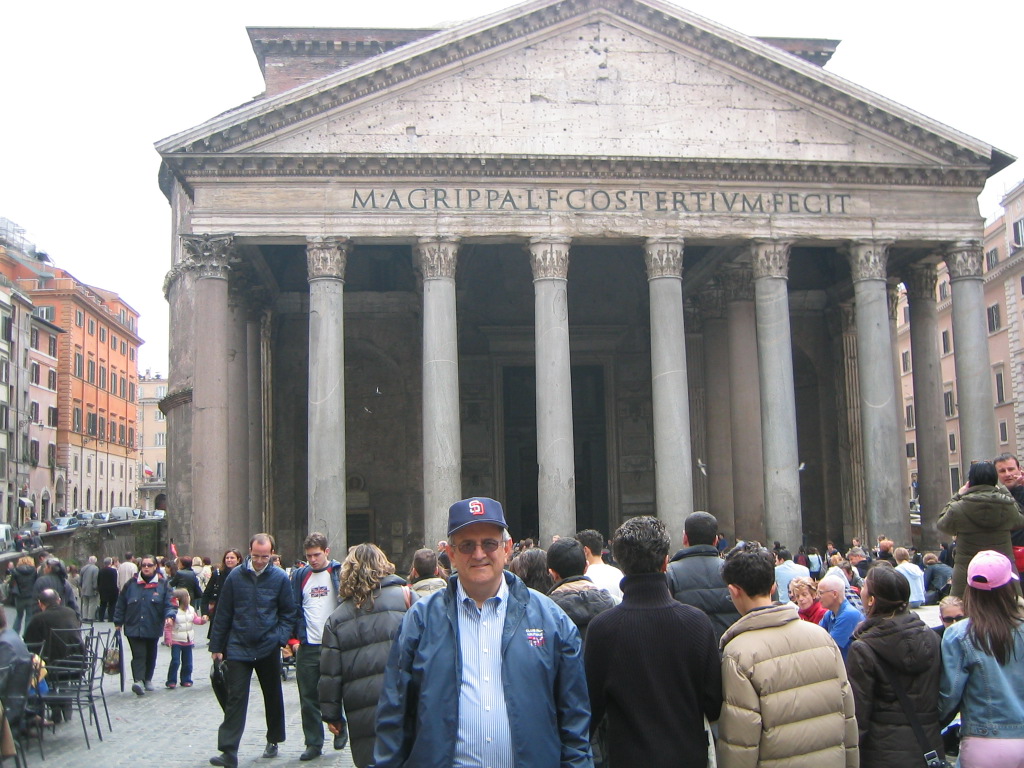
So here are some of my favorite Rome pictures. That's me in front of the Pantheon, just about my favorite historic building in the Eternal City. I had on my San Diego Padres cap and a guy wearing a San Diego Chargers jacket spotted me. It pays to wear sports gear if you enjoy chatting with strangers.
The same thing happened a few years before in Copenhagen. We needed a bathroom, and found one in a classy hotel in the middle of town. While waiting for Vivian, outside the ladies room, I spotted a man wearing a Chargers cap. It turns out he lived in the same part of San Diego as we and his wife and I recognized each other from a donut shop. The bonuses of travel just seem to pop up out of nowhere.
If I could be in any particular spot in Rome, as I write, it would be in the crowd on the Spanish Steps. It is so alive with people from all over the world, an instant happening.
Vivian and I had just climbed the Spanish steps on April 3, 1972 when we stopped for coffee at a cafe. We had just picked up a copy of the International Herald-Tribune. This was many years before the instant communication of the internet and all these new fangled accessories.
Paging through the Trib, Vivian gasped and started to cry. "You won't believe this," she weeped. My boyhood hero and one of her favorite Brooklyn Dodgers, Gil Hodges, had died of a heart attack two days shy of his 47th birthday. At the time he was the manager of the New York Mets. A heavy smoker, Gil was playing golf with his coaches in Florida and reportedly was gone before he hit the ground.
Gil's widow, still living some 40 years later, is the former Joan Lombardi from Brooklyn.
If you haven't been to Rome, put it on your bucket list. It defies the imagination. History is everywhere and the food is sensational.
_____________
The 1954 hit song and movie "Three Coins in the Fountain" brought Rome's Trevi Fountain (Fontana Di Trevi) to the attention of Americans. The film tells the story of three American girls looking for romance in Rome while employed at the American Embassy. They drop coins in the fountain for good luck.
The song received an Academy Award that year and was a No. 1 hit by the Four Aces. Frank Sinatra and Doris Day, among others, recorded popular versions of the song.
We were disappointed to find out that Trevi Fountain is tightly surrounded by buildings so it is difficult to shoot a panorama photo. Close ups of the various statues work best.
The central figure of the fountain, in front of a large niche, is Neptune, god of the sea. He is riding a chariot in the shape of a shell, pulled by two sea horses. Each sea horse is guided by a Triton. One of the horses is calm and obedient, the other one restive. They symbolize the fluctuating moods of the sea.
On the left hand side of Neptune is a statue representing Abundance, while the statue on the right represents Salubrity (the quality of promoting good health). Above the sculptures are bas-reliefs, one of them shows Agrippa, the general who built the aqueduct that carries water to the fountain.
The water at the bottom of the fountain represents the sea. Legend has it you will return to Rome if you throw a coin into the water. You should toss it over your shoulder with your back to the fountain.
Vivian did this in 1966 while in college and again in 1971, so it must work. The photos are from our 2004 trip to Rome. It is estimated that 3,000 Euros are thrown into the fountain each day.
________________
The exotic island of Tahiti is truly in the middle of nowhere. It is somewhere in the Pacific Ocean between Australia and Hawaii. The Barnings have been there twice, both on cruise ship stops.
I love to visit outdoor markets around the world and the photos here well illustrate the appeal. Some of the food items being sold are totally foreign to our American experience. How many fish this color have you ever seen?
Speaking of exotic, nearby are the islands of Moorea and Bora Bora are famous for their resorts and water sports.
From the Tahiti's website you learn:
What Is Tahiti?
Tahiti is the largest of the 118 islands and atolls that constitute what is officially known as French Polynesia. The island of Tahiti and the capital city of Papeete are located in the Society Islands, an archipelago that includes the high-rising islands of Moorea, Huahine, Raiatea, Taha'a, and Bora Bora. Other dramatic island groups are the Tuamotu Atolls with the slender coral wreaths of Rangiroa, Manihi, Tikehau, and Fakarava and the Marquesas - with the massive mountains on the islands of Nuku Hiva and Hiva Oa.
Where Is Tahiti and How Long Does It Take to Get There?
The islands are located south of the equator, in the same time zone as Hawaii, and halfway between California and Australia. Papeete's Faa'a Airport (PPT) is under 8 hours by air from Los Angeles (LAX). From North America, nonstop flights depart LAX nearly every day on Air Tahiti Nui and Air France. Nonstop flights from Honolulu (HNL) to Papeete (PPT) are also available weekly on Hawaiian Airlines.
Bruges /ˈbruːʒ/ in English; Dutch: Brugge, [ˈbrʏʝə]) is the capital and largest city of the province of West Flanders in the Flemish Region of Belgium. It is located in the northwest of the country.
The historic city centre is a prominent World Heritage Site of UNESCO. It is oval-shaped. The city's total population is 117,073 (as of January 2008), of which around 20,000 live in the historic centre. The metropolitan area, including the outer commuter zone, covers an area of 616 square kilometers and has a total of 255,844 inhabitants as of January 2008.
Along with a few other canal-based northern cities, such as Amsterdam, it is sometimes referred to as "The Venice of the North". Bruges has a significant economic importance thanks to its port. At one time, it was the "chief commercial city" of the world.
______
The photos were snapped by Frank Barning in 2003 on our second trip to Bruges. Most well-traveled American tourists haven't visited it because it is out of the way. But those of us who have had the good fortune to go there are taken with the neat little medieval city with its magnificent canals. Yes, I would truly rather be there today. It is a gem.